The Attempted Takeover of Mainstream Media After Ten Years of War in Gaza
Adam Parker
Posted on April 8, 2024
Ten years ago, there were no Israeli troops in Gaza until three Israeli teens went missing in the West Bank. Found dead in Hebron, a wave of riots and mass arrests of Hamas operatives inspired the proscribed terror organisation to unleash a rocket fusillade across its Gazan border.
In return, Israel launched airstrikes followed by a land campaign. After seven weeks degrading Hamas’s firing sites and tunnel networks a truce came. Over 4,000 rockets had been fired at Israel, and of both militants and civilians combined, an estimated 2,000 Gazans and 70 Israelis were dead.
Nine years later, on October 7 2023 Hamas invaded Israel across the its southern Gazan border. In an orgy of violence including gang rape, torture, corpse theft and abuse, hostage taking, and infant kidnapping it killed 1,200 civilians and Israeli soldiers.
Today, while Israel’s fight to eliminate Hamas and recover its hostages is about to reach its crescendo in Rafah, an estimated 130 hostages remain in Palestinian hands and thousands of Hamas operatives and Gazan civilians lay dead.
Hamas called its own invasion “Operation Al-Aqsa Flood”. Israel replied with “Operation Swords of Iron”. In the greatest miscalculation since Palestine refused statehood in 1947, the only thing flooding anything at present is Gaza’s rubble and the blood of Hamas, its diehard supporters and its innocent human shields.
In 2014 the Australian print masthead Sydney Morning Herald, then owned by the iconic Fairfax Media, ran an article critical of Israel’s offensive in Gaza featuring an antisemitic cartoon.
Complaints followed and then exploded when the piece’s journalist took to social media abusing his critics. His subsequent resignation prompted my essay below.
What no one could have foreseen as I reprise it today, however, was the seismic shift in the demographics of Australia, the EU, UK, US and Canada brought on by ten years of illegal Muslim immigration following the rise of ISIS in the aftermath of the 2014 Syrian Civil War.
Nor could anyone have forecast its social media impact on Gen Z and late-Gen Y making them perfect anarchic cannon fodder.
This uncontrolled, violent, Islamist-driven support for Hamas’s October atrocities across the West, has prompted some trusted media entities notably the BBC, Reuters, and Associated Press to parrot Hamas propaganda and fuel antisemitic rhetoric. They’ve done so unashamedly and recanted if ever with reluctance.
Yet, not all media houses have joined their ride. Unlike the BBC, Australia’s public broadcaster ABC and Fairfax, now owned by Nine Entertainment, have ordered staff to practice reporting neutrality.
Some journalists have resigned, some have been sacked, some are seeking legal redress, some are seeking social media fame.
This is where the lessons of Fairfax Media in 2014 come into relevance because history always checks the elasticity of change.
The Online PR Failure of Fairfax Media
First published August 10 2014.
The conflict in Gaza between Israel and Hamas these past weeks has lifted the lid on animosities and biases long thought dead in the West following the collapse of Nazi Germany in 1945.
A ramp up of antisemitism, anti-Zionism, anti-Islamism—the emergence of new categories: Judeophobia, Islamophobia—and the weirdest of all—Likudism (referring to the right-wing political party currently holding the balance of power in the Israeli parliament and a none too hidden wordplay on “Nazism”) have stormed our TVs, our reading material, and our streets.
A few days ago, they hit a business empire too, in Australia of all places, as a once vaunted PR machine failed when it came to managing its online interactions.
Dateline—Saturday July 26 2014
Plastic-wrapped rolls of the Sydney Morning Herald newspaper thumped on pavements across Australia’s most liberal city. Online, its sibling Age newspaper lit up computer screens in Melbourne to the south.
These were the flagship journals of the Fairfax Media Empire, and in them sat a column with a foreboding headline:
Israel’s rank and rotten fruit is being called fascism.
It was an opinion piece, crafted by Australian journalist Mike Carlton and if not for a cartoon that accompanied it, readers might have lounged unaware.
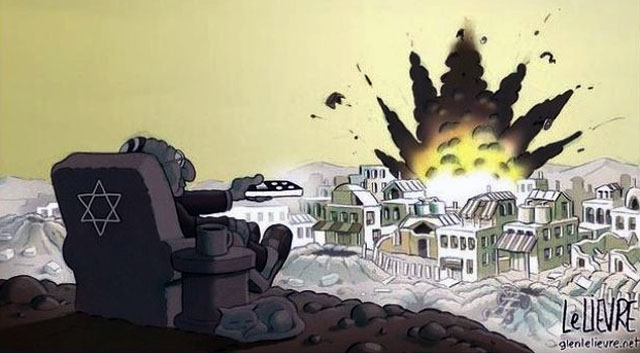
That cartoon’s message was blatant though. The work of Australian-based illustrator of New Yorker magazine fame Glen Le Lievre, it conjured up days of a 1930s Third Reich propaganda rag Der Sturmer. The caricature with its stereotypically Jewish nose started passions rolling.
And a PR nightmare was just beginning to hit the fan.
Carlton’s article led off with a descriptive scene from the streets: “The images from Gaza are searing, a gallery of death and horror”. It continued with an account of the reported injury toll; it spoke of destruction, occupation, and of a former Australian Prime Minister [Malcolm Fraser] who’d labelled Israel’s combat stance a “war crime” (this same PM had recently called for an end to the US-Australian alliance).
It admitted: “Yes, Hamas is also trying to kill Israeli civilians, with a barrage of rockets and guerrilla border attacks. It, too, is guilty of terror and grave war crimes”.
Personally, I saw nothing scandalous in the piece. [Notably 10 years later his accusation of Israeli “genocide” then makes the same sloganeering today so passé.] Indeed, it was impassioned. But as a writer of opinion too, I’m a fervent believer in free speech—to the extent that it never amounts to vilification or defamation. For so long as a person who vehemently disagrees with me is allowed to say such, I possess the right of reply.
There certainly were things technically wrong with the article. Its geo-political analysis was lightweight, its military insight missing, and its knowledge of law pertaining to international conflict confused.
All these deficiencies were very surprising, considering that 68-year-old Carlton, a long-standing journalist, had earned his stripes in the war-ravaged jungles of Vietnam. But then there was that cartoon.
And something else happened.
From the get-go, readers bombarded Carlton in protest using Fairfax-supplied email addresses and Twitter feeds. They inundated the editors of the Sydney Morning Herald with caricature-driven ire.
Eventually, Carlton erupted.
Through Tweets and email replies he began telling critics to “fuck off.” He used the phrase, “Jewish bigot” once.
What Carlton forgot in all this, was that these critics were the customers of Fairfax’s newspapers.
They weren’t his to respond to at all.
Dateline – Monday August 4, 2014
With complaints unabated, including allegations by Australian attorney general George Brandis of antisemitic vilification and disgust voiced by federal communications minister Malcolm Turnbull, the Sydney Morning Herald launched a full editorial apology:
“There has been widespread reader and community reaction during the past 10 days over a cartoon that was used to illustrate an opinion piece by columnist Mike Carlton on the conflict in Gaza … The cartoon showed an elderly man, with a large nose, sitting alone, with a remote control device in his hand, overseeing explosions in Gaza. The armchair in which he was sitting was emblazoned with the Star of David, and the man was wearing a kippah, a religious skullcap. A strong view was expressed that the cartoon, by Glen Le Lievre, closely resembled illustrations that had circulated in Nazi Germany. These are menacing cartoons that continue to haunt and traumatise generations of Jewish people … The Herald now appreciates that, in using the Star of David and the kippah in the cartoon, the newspaper invoked an inappropriate element of religion, rather than nationhood, and made a serious error of judgment. It was wrong to publish the cartoon in its original form”.
Two days later, Mike Carlton resigned. In an interview with Australia’s Nine News Network, he said, “And then I got a call later at night from someone higher up the Fairfax food chain just stating quite blandly ‘we are going to suspend you for four to six weeks to consider’ … at that point I interrupted and said ‘don’t go to any trouble, I’ve resigned’ and hung up”.
Fairfax’s director of news and business media Sean Aylmer was more forthcoming. He prefaced a second apology by the paper:
The column attracted a lot of criticism. Many readers wrote to Mike—what got him into trouble was the way he responded to those readers.
Indeed, as Fairfax’s largest competitor News Corp reported in its Australian newspaper: “Several employees expressed concern to Aylmer that this was not appropriate behaviour for a senior columnist. It would not be acceptable for any other Fairfax journalist and Carlton’s behaviour was damaging The Sydney Morning Herald’s brand”.
And there lies the rub.
The PR dangers of online customer interaction
The PR nightmare that Fairfax finds itself in at present is not one purely of an editorial making —though the company rightly admits some terrible lapses in editorial judgment.
Its basis rests in giving employees and contractors unrestricted access to its online customers. Doing so can effectively kill a brand.
I’ve never understood why publishers provide authors, writers, and journalists with public email and Twitter accounts, and then encourage them “to go and mix it up”.
Brands are delicate entities: they require nurturing, polishing, defending, and closely managed airing. Why would any business deregulate the way its lifeblood is promoted?
Giving a columnist free reign with irate readers, is akin to putting your customer service in the hands of overseas telemarketing centres whose operators can barely string a coherent fact-finding session together.
Yet, every day, businesses are doing just that.
And the printing presses at Fairfax are now spluttering with both Jewish and Muslim community groups threatening a boycott.
How this all could have been avoided
There are some Golden Rules when it comes to marketing. Unhappy customers will privately tell 8-20 others of their complaint. Unhappy customers will publicly tell an unlimited number of others via social media. And for every unhappy customer that lets a business know, 26 others will not.
How many of Fairfax’s readers might jump ship given a few hundred complaints caused by Mike Carlton’s actions? This multiplier effect sets the online parameters for what’s at stake.
We’ve all seen policies lumped on employees regarding the use of social media in their private time. Typical of these goes: “Don’t talk on behalf of the company especially to the media without explicit permission. It will be grounds for dismissal”.
But what happens when explicit permission has been granted, as was the case with Mike Carlton? Here the answer is quite simple: don’t release it lightly.
It’s great in general to leverage the power of social media these days and hope for a more interactive client engagement. But that optimum concept remains the realm of theory.

There is a photo of Israelis watching the bombardment of Gaza from a hilltop across the border. It purportedly inspired the cartoon used by the Sydney Morning Herald and was Tweeted by Le Lievre after complaints started flooding in.
Look closely. There’s no remote control in anyone’s hand. No celebration. In fact, without a follow-up interview, nothing about the onlookers’ perceptions can be gauged.
So, you add a crooked nose, a Star of David on the seat-back and anyone could have guessed that a multifaceted PR nightmare was in the making.
All it required was an unregulated voice to topple the Jenga. And former Fairfax journalist Mike Carlton (whose son-in-law is Jewish) supplied it. The real question, therefore, is straightforward in scope.
Why was he ever left alone to use it?
© 2014, 2024 Adam Parker.
Cartoon credit: © 2014 Fairfax Media (via haaretz).
Tagged: Fairfax, Gaza, Hamas, Immigration, Israel, Journalism, Mike Carlton, Propaganda, Sydney Morning Herald
 Adam Parker Presents
You must be logged in to post a comment.